 Sui
Sui
Sui staking rewards require a full epoch of active delegation
Sui staking delegates SUI to a validator, and native rewards require a complete epoch of active participation. A new stake with an active validator begins counting at the next epoch boundary. Rewards for that epoch become payable after it closes if the validator pool earns them. Unstaking earlier returns principal without rewards for the unfinished epoch.
Last updated -
The activation epoch answers when earning can begin. The validator’s performance and commission determine the amount the pool ultimately credits. Native delegation and liquid staking share underlying validator economics, while differing in ownership, liquidity, and withdrawal terms.
Key takeaway: Validator commission and performance determine how much a completed active epoch adds to an eligible stake.
Pending delegation and completed active epochs
An owned stake object can exist before its rewards become payable. Reward eligibility requires that stake to remain active throughout a completed epoch in a pool earning validator rewards.
Pending stake before activation
The system Move package wraps the chosen SUI in a self-custodial StakedSui object. Its fields identify the pool, principal, and activation epoch. For a delegation to an active validator, activation occurs in the following epoch. The remainder of the submission epoch does not earn staking rewards. Confirming the transaction proves creation of the position without establishing any reward credit.
Active stake before the first reward
Activation begins the eligible period. A native stake earns rewards only for epochs in which it remains active for the entire epoch. Withdrawing during its first active epoch leaves no completed active epoch to reward. Continuing beyond that boundary makes the completed epoch eligible, subject to the validator’s reward allocation. The network’s epoch progression determines eligibility, so a wallet countdown is useful only when it tracks the same boundary.
When can native stake be withdrawn?
A successful call to the native unstaking function consumes the selected stake object and returns its principal plus accumulated completed-epoch rewards in the transaction. Withdrawal does not wait for the current epoch to end or include that epoch’s unsettled rewards. An unfinished epoch does not erase older rewards, and the consumed object stops earning future rewards. The validator’s effective stake changes at epoch reconfiguration, on a different schedule from the user’s returned SUI.
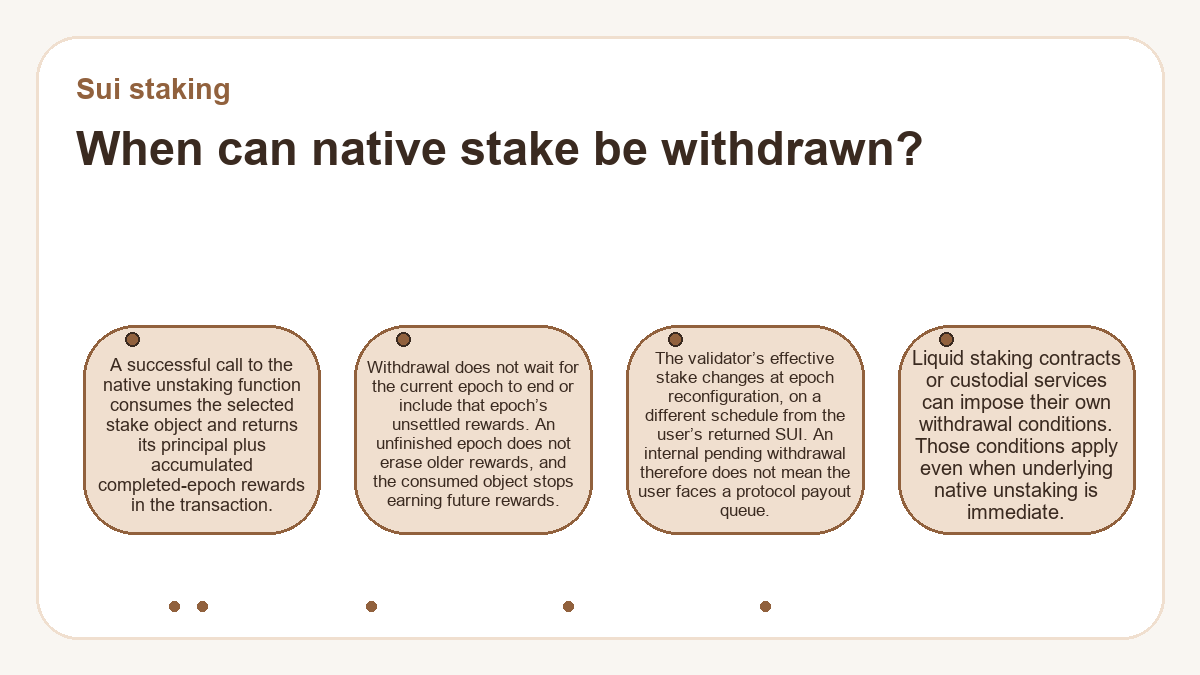
An internal pending withdrawal therefore does not mean the user faces a protocol payout queue. Liquid staking contracts or custodial services can impose their own withdrawal conditions. Those conditions apply even when underlying native unstaking is immediate.
Spendable SUI for transaction gas
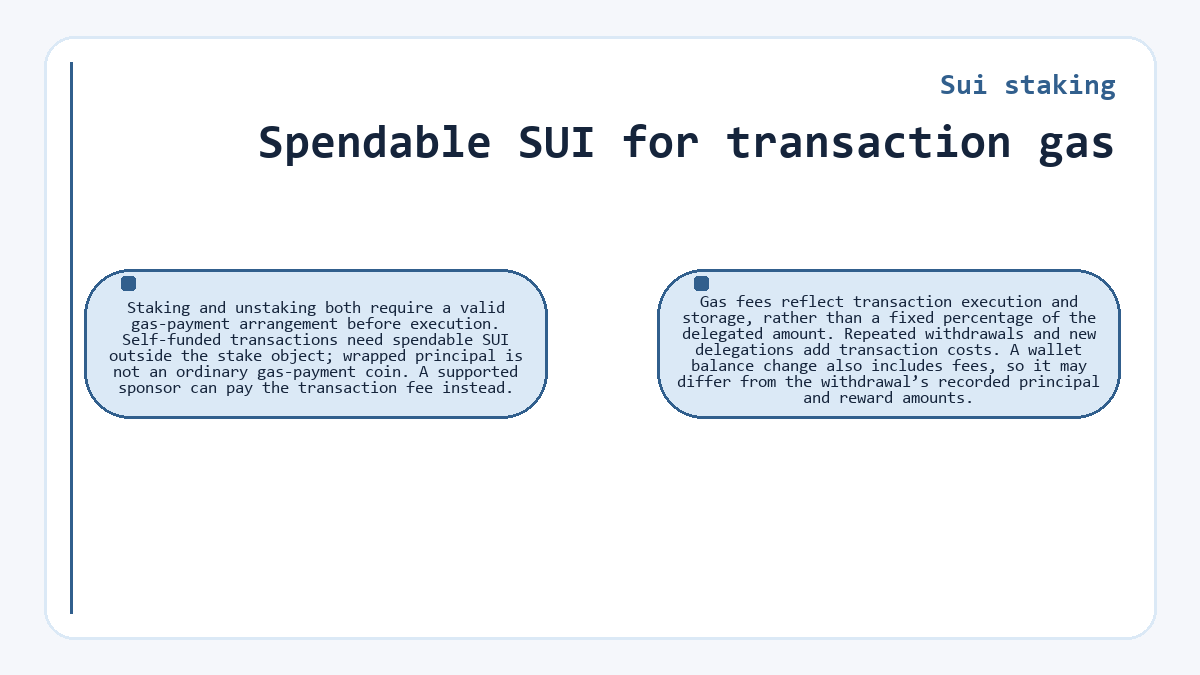
Staking and unstaking both require a valid gas-payment arrangement before execution. Self-funded transactions need spendable SUI outside the stake object; wrapped principal is not an ordinary gas-payment coin. A supported sponsor can pay the transaction fee instead. Gas fees reflect transaction execution and storage, rather than a fixed percentage of the delegated amount. Repeated withdrawals and new delegations add transaction costs. A wallet balance change also includes fees, so it may differ from the withdrawal’s recorded principal and reward amounts.
Validator commission, performance, and pool activity
An active validator’s commission and performance influence the rewards its delegators receive, so the same eligibility period can produce different rewards in different pools. Validator selection also affects exposure to a pool leaving the active set.
Commission changes between epochs
Commission gives the validator a share of staking rewards. It does not take that percentage from the deposited principal. The framework distinguishes the commission applying in the current epoch from the rate scheduled for the next epoch, so an initially low commission need not persist.
Yield comparisons need a consistent basis. A displayed annual percentage yield, or APY, estimates returns using its stated assumptions, while future distributions depend on actual epoch rewards. Its treatment of commission matters when comparing pools. Deducting commission again from a figure already stated after fees would count the same charge twice.
Performance penalties and inactive pools
Performance penalties can remove all of a validator’s rewards for an epoch, causing delegators in that pool to miss the corresponding rewards even if their stakes were active throughout; commission alone cannot describe that exposure.
A deactivated pool stops earning new rewards, although existing stakes remain withdrawable. A candidate pool has not yet joined the active validator set, so its ability to receive a stake does not establish active participation. Matching the pool’s status to the stake’s activation record avoids treating a candidate or inactive pool as an earning position.
How do native rewards compound?
Native rewards compound through each validator pool’s changing exchange rate between accounting shares and SUI. Native staking rewards compound without a separate claim-and-restake transaction after each epoch. Compounding follows actual rewards credited to the pool.
The principal field in StakedSui records the deposited SUI, while reward growth appears in the pool’s exchange-rate accounting. The field need not increase every epoch. Withdrawal uses the stake’s activation history and the applicable later exchange rate to calculate earned SUI; these accounting shares differ from a transferable liquid staking token issued by an application. Rewards increase the amount of SUI attributable to a stake. They do not fix its value in another currency. Changes in token price and transaction costs therefore affect a different calculation from the pool’s reward accounting.
Reward funding combines computation fees with any configured stake subsidies for the epoch. Subsidies follow the network’s allocation and release mechanism; they are not a permanent fixed return. The storage fund also participates in stake accounting, with its reward share supporting validator storage costs. Consequently, the network’s total reward allocation is not simply a balance available equally to every delegator.
Native stake objects and liquid staking tokens
Native delegation keeps the stake in a self-custodial StakedSui object. A liquid staking protocol can issue a transferable token representing staked value and provide uses in decentralized finance, or DeFi. This adds application-contract and redemption considerations. Support for the token varies between applications, and its market price can differ from its redemption value. Selling the token transfers the associated stake claim. The underlying validator rewards still follow epoch accounting; additional DeFi returns follow the application’s own mechanisms.
Native delegation confirmation before rewards accrue
Before submitting a native delegation, identify the intended validator pool, principal, and owner of the resulting StakedSui object. A successful transaction creating that matching object confirms the deposit, independently of any projected reward.
- Use native SUI and confirm the selected validator is active.
- Arrange gas payment before committing the amount to stake.
- Review the intended validator and principal before authorizing the staking transaction.
- Compare the successful transaction’s resulting StakedSui object with the expected pool, principal, and owner.
- Check the recorded activation epoch against the network’s epoch before interpreting a zero reward display.
If the observed object matches those details, the native delegation has completed even while it has no payable rewards. A transaction identifier alone does not establish success. A failed transaction or a receipt for another pool does not confirm the requested delegation.
With the deposit confirmed, the next choice is whether to keep that stake active through a complete epoch or withdraw it before that epoch closes. Only the first path can earn that epoch’s rewards, and the pool’s performance and allocation determine what it earns.
Key questions about Sui staking
Can I withdraw just part of a native SUI stake?
The Sui framework supports partial withdrawal by splitting a StakedSui object and withdrawing one resulting part. Each resulting part must contain at least 1 SUI of principal; otherwise, the split transaction aborts. The split preserves their validator pool and activation epoch, so the retained part keeps its existing reward history. Wallet interfaces may not expose this operation. Separate existing stake objects can also be withdrawn individually.
Does adding SUI to a validator restart an existing stake?
A new native delegation creates its own StakedSui object and activation epoch without restarting an existing stake. The older object retains its recorded principal and staking history. An interface may group positions visually, but each object carries its own eligibility record. Newly delegated SUI does not inherit the older stake’s reward eligibility.
Will transferring a StakedSui object reset its activation epoch?
Transferring a StakedSui object changes its owner without resetting its stored activation epoch or pool. The recipient receives the stake object carrying its principal and reward history. A transfer does not unstake the SUI or create a fresh delegation. The address receiving the object controls its later withdrawal, subject to valid authorization. An interface may not provide a stake-transfer option.
Why can two stakes in the same validator pool fail to merge?
Native stake joining requires matching activation epochs as well as matching pool IDs. Sharing a validator alone does not satisfy that requirement. Delegations created in different epochs can therefore remain separate even under the same wallet address. The joining function checks their staking metadata and rejects incompatible objects; their principal amounts do not have to match.
How does switching validators affect already earned rewards?
Withdrawing the old native stake includes its earned rewards from completed eligible epochs. A delegation to another validator uses a different pool and starts its own activation period. Earlier participation does not carry the old activation epoch into the new object. Supported interfaces can combine withdrawal and new staking in a programmable transaction block, but this does not remove the new stake’s activation requirement.
Are native rewards tied to an open wallet connection?
Native rewards accrue without an open wallet connection while the stake remains eligible in an active, reward-earning pool. The network performs epoch accounting independently of the wallet interface. Later withdrawal still requires access to the address owning the StakedSui object and a valid transaction authorization.
What does a liquid staking token balance measure?
A liquid staking token balance counts the protocol’s receipt tokens, whose SUI value follows its accounting rules. That count need not equal the SUI originally committed. Redemption value describes the underlying claim, while a swap quote describes the output available from a particular trade. These amounts can differ because the token’s market price and liquidity need not match its redemption terms.